

As we move into 2026, the artificial intelligence landscape is shifting from “experimental hype” to “industrial utility.” The focus has moved beyond chatbots that simply answer questions to autonomous systems that execute complex workflows.
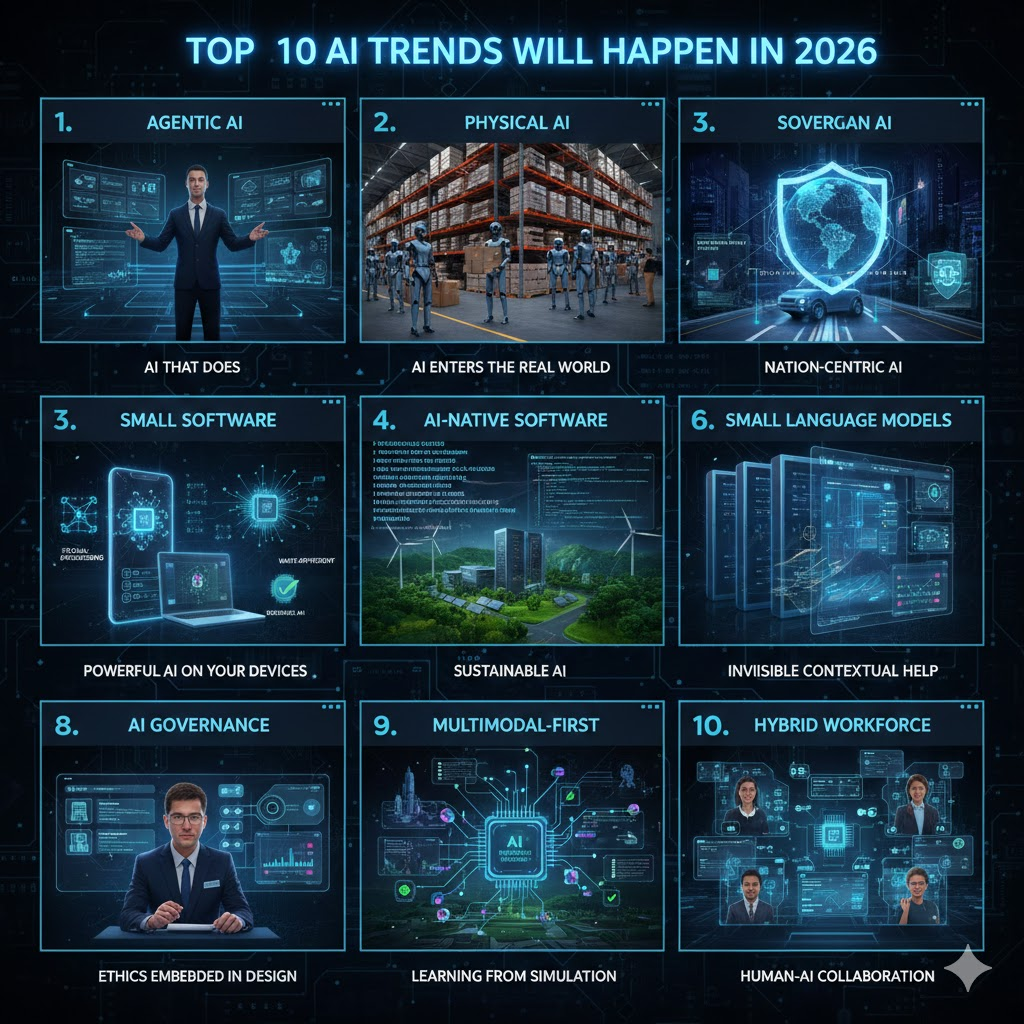
Here are the top 10 AI trends defining 2026:
1. The Rise of Agentic AI
The era of the “AI Copilot” is evolving into the era of the AI Agent. Unlike traditional LLMs that require step-by-step prompting, agentic systems can reason, plan, and take actions across multiple software tools to complete a goal (e.g., “Plan and book a 3-day business trip within budget”).
Key Shift: Moving from AI that “talks” to AI that “does.”
2. Physical AI (Embodied Intelligence)
AI is leaving the screen and entering the physical world. Breakthroughs in foundation models for robotics (like Nvidia’s Cosmos) allow machines to understand the laws of physics. We are seeing a surge in humanoid robots in warehouses and “Physical AI” in autonomous vehicles that can navigate complex, unmapped environments.
3. Sovereign AI and “Geopatriation”
Nations and large enterprises are prioritizing Sovereign AI—developing their own models and data centers within their borders. This trend is driven by a need for data privacy, security, and independence from global tech giants, ensuring that AI reflects local laws and cultural values.
4. Small Language Models (SLMs) and “Edge AI”
While frontier models (like GPT-5 or Gemini 2) remain massive, 2026 is the year of the Small Language Model. These are highly efficient models trained on high-quality, specialized data that can run locally on smartphones, laptops, and IoT devices without needing a constant internet connection.
5. AI-Native Software Development
We are moving away from “AI-enabled” software to AI-native applications. In 2026, software is increasingly built by AI for AI. English is becoming the “hottest programming language,” as natural language becomes the primary way for humans to architect complex systems, with AI handling the underlying code and infrastructure.
6. The “Energy Reckoning” & Green AI
The massive energy and water demands of AI data centers have hit a bottleneck. This has forced a shift toward Sustainable AI, focusing on energy-efficient chips (like Blackwell and beyond) and “inference economics,” where companies prioritize the most “watt-efficient” way to run a model.
7. Multimodal-First Interactions
Text-only interaction is becoming a legacy feature. AI in 2026 is natively multimodal, meaning it processes video, audio, and text simultaneously in real-time. This is powering “Invisible AI”—voice assistants that can “see” through your glasses or phone camera to provide context-aware help without you typing a word.
8. Synthetic Data & The “Chinchilla Wall”
As the world runs out of high-quality human-generated text to train on, AI companies are turning to Synthetic Data. Models are now being trained on data generated by other models or through “world simulations,” allowing AI to learn logic and physics in virtual environments before being deployed.
9. AI Governance & Self-Verification
With 60% of Fortune 100 companies now employing a Head of AI Governance, ethics has moved from philosophy to engineering. New models feature “Self-Verification” loops, where the AI checks its own work against facts and logic before presenting an answer, significantly reducing hallucinations.
10. The New Hybrid Workforce
The debate over “AI vs. Humans” is shifting toward Human-AI Collaboration. In 2026, most knowledge workers act as “managers” of multiple AI agents. Success in the job market now depends on “AI Fluency”—the ability to delegate to, audit, and direct autonomous systems.
Would you like me to dive deeper into one of these trends, such as how to prepare your career for the “Agentic AI” shift?




Leave a Reply