

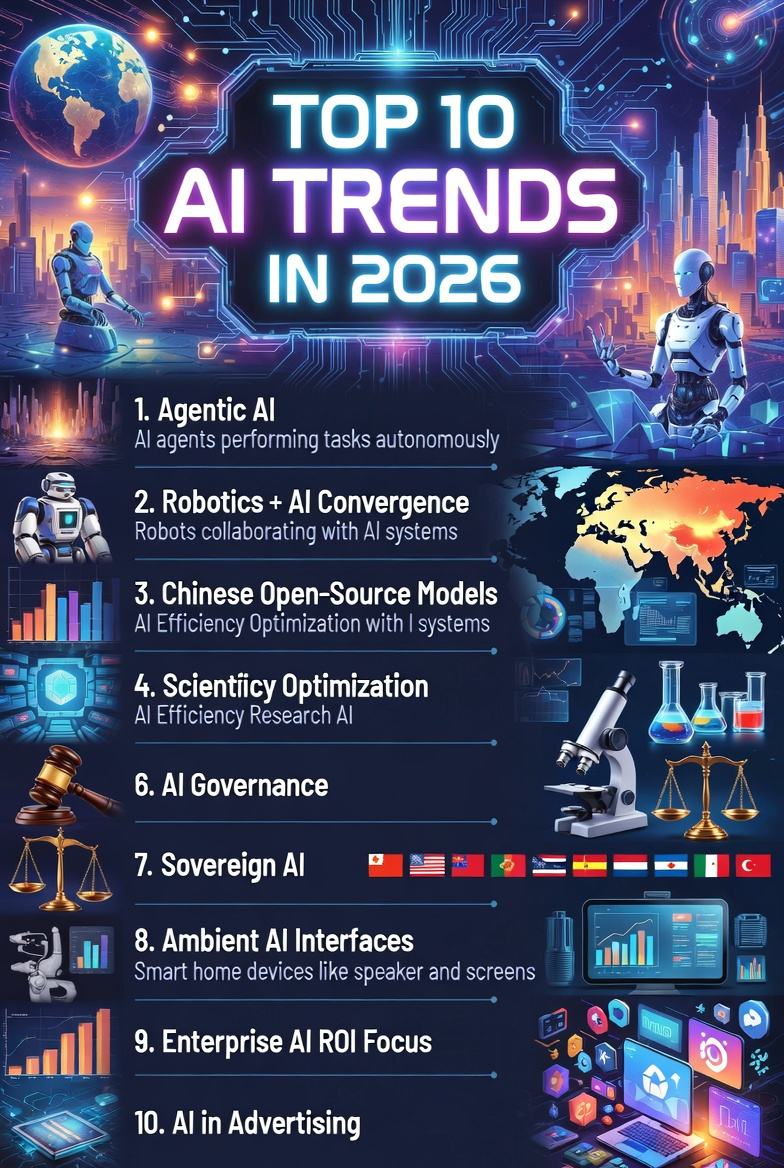
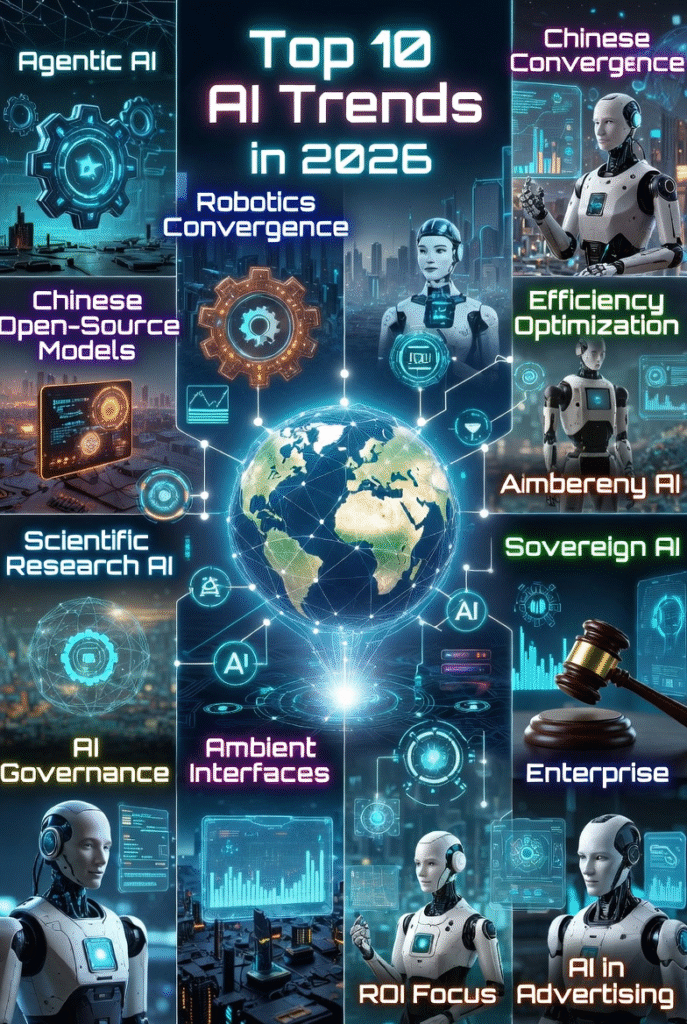
Here are the Top 10 AI Trends that are poised to dominate and actually happen in 2026, based on recent expert analyses from sources like Gartner, Microsoft, IBM, Forbes, MIT Technology Review, and others (as of early January 2026).
These reflect the shift from experimentation and hype to real-world deployment, efficiency, physical integration, and accountability.
1. Agentic AI & Multi-Agent Systems Become Mainstream
AI evolves from chat-based tools to autonomous “digital coworkers” that handle complex, multi-step workflows (e.g., booking travel, managing supply chains, or running end-to-end processes). Enterprises will embed task-specific agents in 40%+ of applications, with orchestrated multi-agent systems coordinating dozens or hundreds of specialized agents.
This is widely called the defining trend of 2026 by Microsoft, IBM, Gartner, and Forbes.
2. Physical AI & Robotics Convergence Takes Off
AI “goes physical” — humanoid and specialized robots move from lab demos to targeted pilots in factories, warehouses, logistics, and even homes. Expect breakthroughs in embodied AI reducing defects, boosting output, and shortening cycles (e.g., Tesla Optimus, Figure, Agility deployments).
Gartner lists “Physical AI” as a top strategic trend, with Deloitte highlighting the “convergence of AI and robotics.”
3. Rise of Chinese Open-Source Models & Shrinking Western Lead
Chinese models (e.g., from DeepSeek, Qwen, and others) continue closing the gap — often matching or surpassing Western frontiers in efficiency and cost. More Silicon Valley apps quietly build on them, with release lags shrinking from months to weeks.
MIT Technology Review predicts this as a major 2026 shift, amid growing AI sovereignty efforts.
4. Efficiency & Hardware Optimization Over Pure Scaling
The focus shifts from endless scaling to hardware efficiency, inference economics, specialized chips (ASICs, chiplets, analog), edge/on-device deployment, and hybrid cloud-local systems. Small/fine-tuned domain-specific models (SLMs/DSLMs) become the enterprise default for cost and control.
IBM, Gartner (“AI Supercomputing Platforms” & “Domain-Specific Language Models”), and multiple reports emphasize this as the “new scaling strategy.”
5. AI Becomes Central to Scientific Research & Discovery
AI actively participates in the research process (not just summarizing papers) — accelerating breakthroughs in physics, chemistry, biology, materials, and medicine. Expect a “ChatGPT moment” in medicine and more AI-native discovery tools.
Microsoft Research and Stanford experts highlight this as a key leap for 2026.
6. AI Governance, Security & Provenance Become Critical
With agentic risks (breaches, hijacking, deepfakes) surging, expect mandatory AI security platforms, confidential computing, digital provenance, preemptive cybersecurity, and strong governance. Overreliance on GenAI may atrophy critical thinking, leading to “AI-free” skills assessments in hiring.
Gartner ranks several security/governance trends in its top 10 for 2026, with Forbes warning of identity as the main battleground.
7. Sovereign AI & Geopolitical/Regulatory Battles Intensify
Countries push for AI independence (sovereign compute, data control) amid export restrictions, tariffs, and regulations. AI becomes a central midterm election issue in the US, with complex politics around jobs, security, and energy demands.
Forbes, Stanford, and multiple geopolitical analyses flag this as a defining 2026 theme.
8. From Chatbots to Robots & Ambient/Edge Interfaces
Voice, multimodal, and embodied interfaces explode — AI moves to always-on devices (wearables, smart homes, robots) and edge-first personal agents. Generative UI, voice as a primary signal, and ambient computing reduce reliance on screens.
NVIDIA demos, Microsoft, and CES 2026 coverage point to this shift from “copilot” to “autopilot.”
9. Enterprise Reality Check: ROI Focus & Workflow Emphasis
The hype deflates somewhat — focus on proven ROI, AI workflows (not just standalone agents), and vertical/niche solutions. Mid-market companies become big buyers, while many agentic projects face cancellations due to costs and governance issues.
MIT Sloan, YouTube data-backed analyses, and Deloitte describe 2026 as the year the “promise-reality gap narrows.”
10. Advertising, Commerce & Everyday Integration Surge
AI-driven shopping, agentic commerce, contextual/voice ads, and AI companions/relationships boom. Chatbots gain ads, AI handles high-intent queries, and personalized experiences disrupt retail.
McKinsey, Forbes, and multiple reports predict trillions in agentic commerce potential.
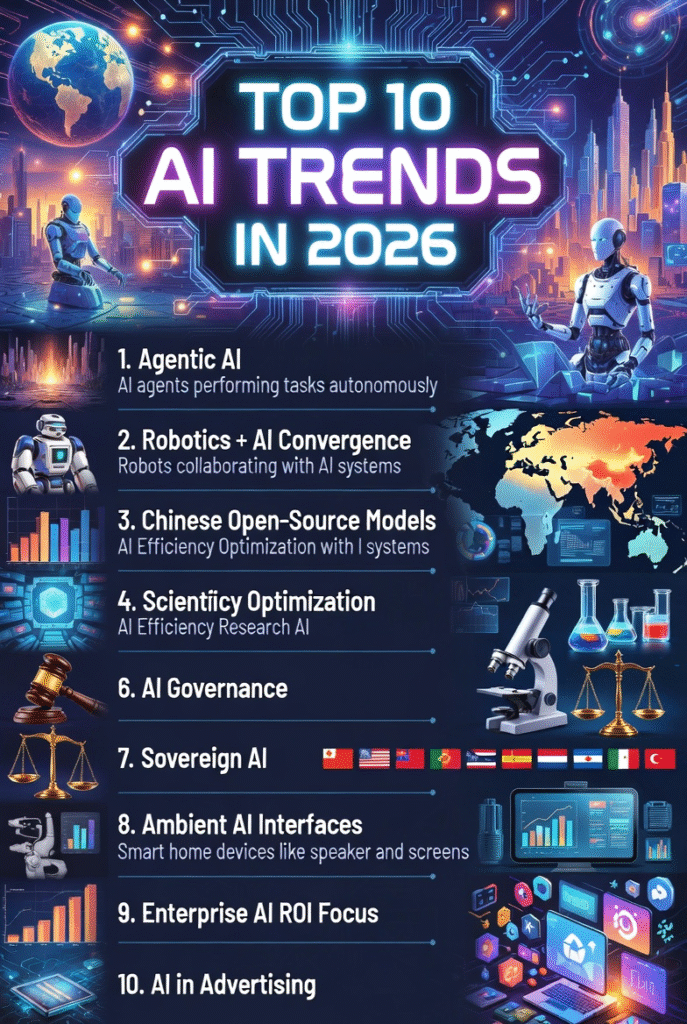
Visual Highlights of Key Trends
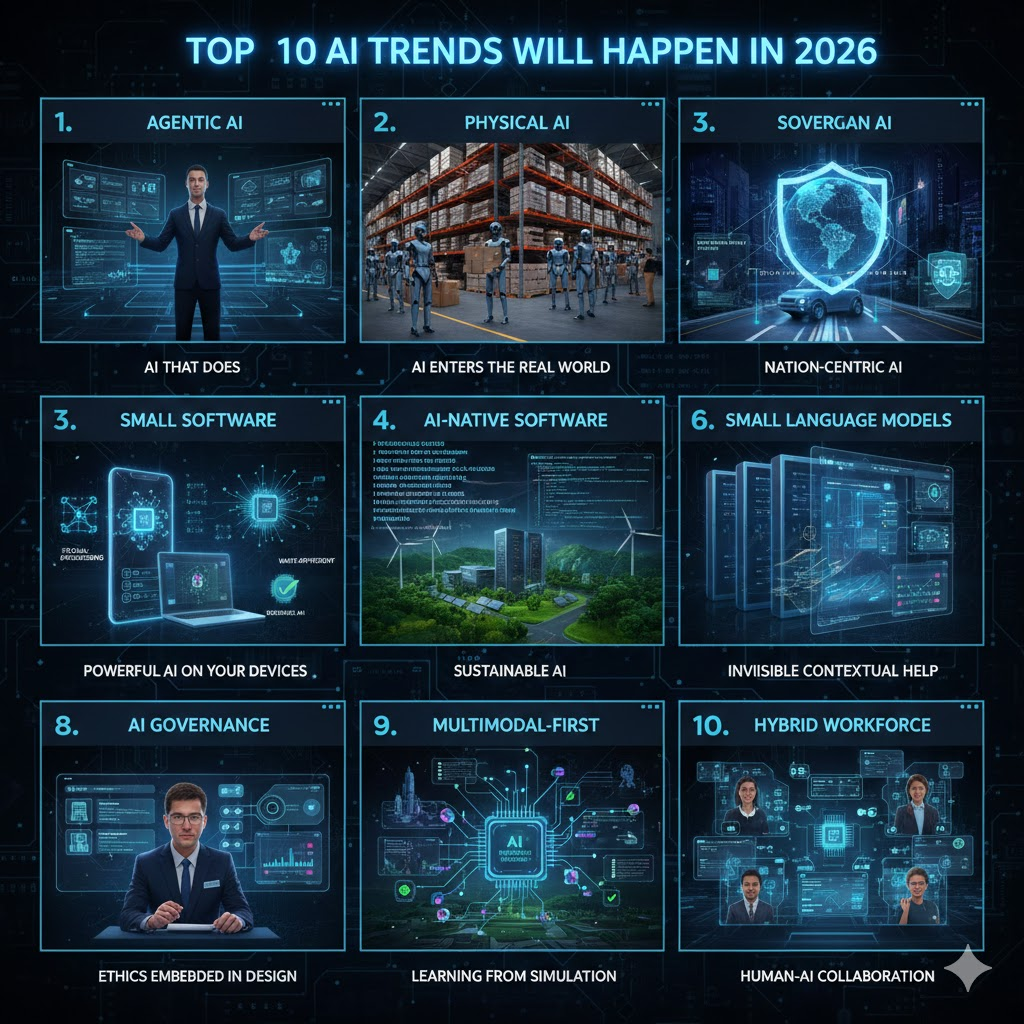
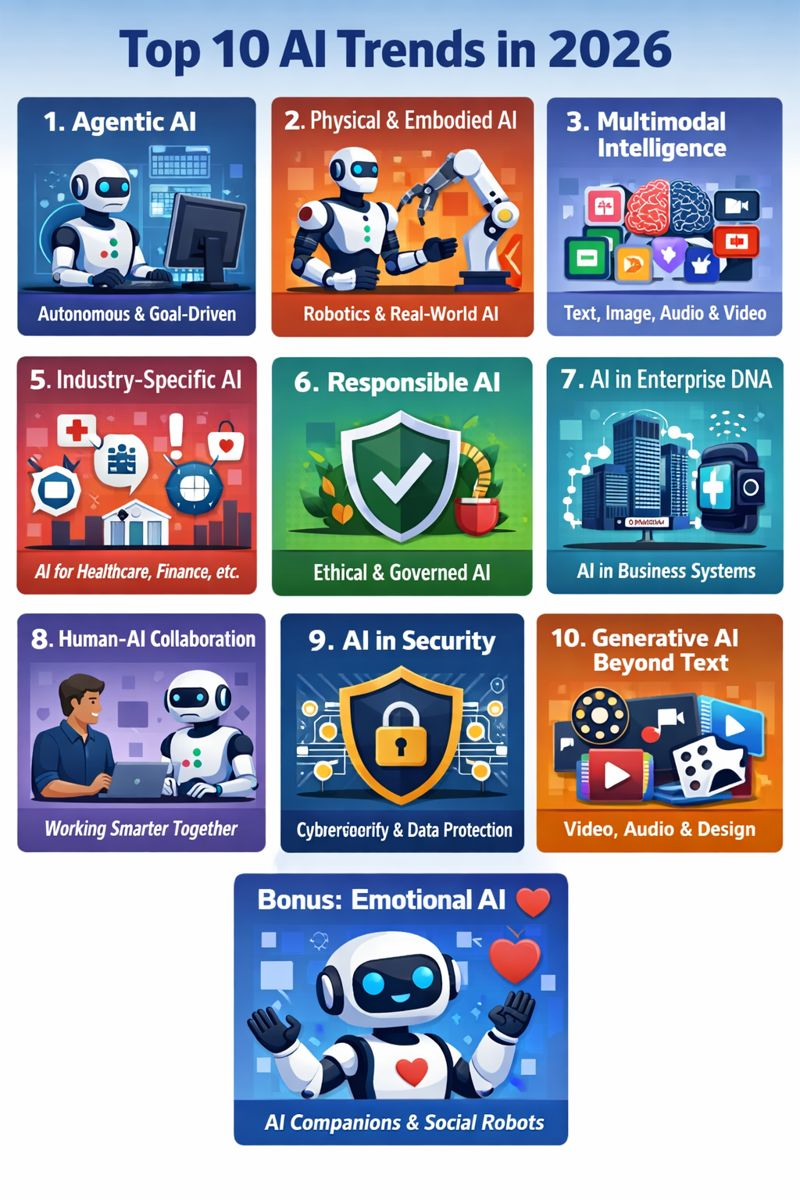
Here are some illustrative images to show what these trends look like in practice:
2026 marks the year AI stops being “coming soon” and starts delivering measurable, sometimes uncomfortable, transformation. Which of these excites (or worries) you the most? 🚀




Leave a Reply